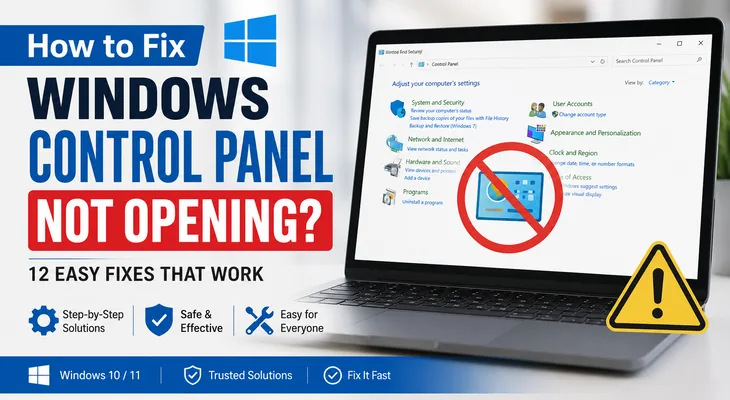
Is Windows Control Panel not opening when you try to access it? You may click its shortcut, search for it from the Start menu, or try opening it through Run, but nothing happens.
Sometimes Control Panel may open and immediately close, become unresponsive, or fail to launch altogether.
The good news is that you don’t necessarily need to reset or reinstall Windows. In this guide, we’ll show you several practical ways to troubleshoot and fix the Windows Control Panel not opening problem.
Tip: Start with the easier solutions first. Move to advanced repair and recovery options only if the basic fixes don’t work.
Why Is Windows Control Panel Not Opening?
There isn’t always one single cause. The problem can be related to:
- Corrupted Windows system files
- Damaged Windows components
- Windows Explorer problems
- Recent Windows updates
- Third-party software conflicts
- Malware or unwanted software
- User-profile problems
- Recent driver or software changes
- Other Windows configuration issues
Let’s start with the simplest solutions.
1. Restart Your Computer
A temporary Windows process or background service may prevent Control Panel from launching.
To restart your PC:
- Click Start.
- Select Power.
- Click Restart.
- Wait for Windows to restart.
- Try opening Control Panel again.
If Control Panel works after the restart, the problem may have been temporary.
If it still doesn’t open, continue to the next solution.
2. Open Control Panel Using the Run Command
This is one of the quickest ways to determine whether Control Panel itself can launch.
Press:
Windows + R
Type:
controlThen press Enter.
You can also try:
control.exeMicrosoft specifically documents Windows + R, followed by control, as a way to open Control Panel.
What if Control Panel opens this way?
If it opens through Run but doesn’t open from Start or Search, the problem may be related to the Windows interface rather than Control Panel itself.
You can then investigate your Start menu if it is also malfunctioning.
Internal link: Windows 10 Start Menu Not Working: Easy & Best Fixes
3. Restart Windows Explorer
Windows Explorer manages important parts of the Windows user interface. Restarting it can resolve temporary interface problems.
How to restart Windows Explorer
- Press Ctrl + Shift + Esc.
- Open Task Manager.
- Find Windows Explorer.
- Right-click it.
- Select Restart.
- Wait a few seconds.
- Try opening Control Panel again.
This doesn’t delete your personal files.
4. Run DISM to Repair Windows Components
If Windows components are damaged, Microsoft’s built-in Deployment Image Servicing and Management (DISM) tool can help repair the Windows image.
Microsoft recommends using DISM and then SFC when troubleshooting corrupted or missing Windows system files.
Run DISM
- Open Start.
- Search for Command Prompt.
- Right-click Command Prompt.
- Select Run as administrator.
- Click Yes if Windows asks for permission.
Enter:
DISM.exe /Online /Cleanup-image /RestorehealthPress Enter.
Wait for the process to finish. It may take several minutes.
Don’t close the Command Prompt window while DISM is running.
5. Run System File Checker
After DISM finishes, run the System File Checker.
In the same Administrator Command Prompt window, enter:
sfc /scannowPress Enter.
Wait until the scan reaches 100%.
SFC checks protected Windows system files and can repair corrupted files. Microsoft recommends DISM before SFC when using these tools to repair Windows system-file problems.
When the scan finishes:
- Close Command Prompt.
- Restart your computer.
- Try opening Control Panel again.
6. Check Windows Update
If Control Panel stopped working after a Windows update, investigate Windows Update.
Open:
Settings → Windows Update
Check for available updates.
If appropriate, install the available updates and restart your PC.
However, if the problem started immediately after a particular update, you may need to investigate that update instead of simply installing more updates.
For related troubleshooting, see:
Internal link: Windows 10 Updates Fail to Install: Easy & Best Fixes
7. Scan Your Computer for Malware
Malware can interfere with Windows applications and system components.
Use Windows Security to perform a scan.
Run a Full Scan
- Open Windows Security.
- Select Virus & threat protection.
- Click Scan options.
- Select Full scan.
- Start the scan.
Let Windows Security finish the scan.
If it detects a threat, follow the recommended actions.
Avoid downloading random “Control Panel repair” programs from unknown websites. Windows’ built-in tools are a safer starting point.
8. Try Windows Safe Mode
If Control Panel doesn’t work during normal Windows startup, try Safe Mode.
Safe Mode starts Windows with a limited set of drivers and services. This can help determine whether a third-party application, driver, or startup service is interfering with Control Panel.
If Control Panel works in Safe Mode but not during normal startup, recently installed software or drivers may be responsible.
You can learn more here:
Internal link: Windows 10 Safe Mode
9. Perform a Clean Boot
A clean boot starts Windows with a minimal set of startup programs and services.
This can help identify conflicts caused by third-party software.
A clean boot is especially useful if:
- Control Panel worked previously
- You recently installed software
- You installed a new driver
- Control Panel works in Safe Mode
- The problem appears only after Windows starts normally
If Control Panel works after a clean boot, gradually re-enable startup applications and services until you identify the software causing the problem.
10. Test Another Windows User Account
Sometimes the Windows installation itself isn’t the problem. The issue may be limited to your current user profile.
If possible, sign in with another Windows account and try opening Control Panel.
If it works in the other account
That can indicate a problem with your original user profile.
In that situation, you can investigate the affected profile rather than immediately reinstalling Windows.
11. Use System Restore
If Control Panel worked normally before a recent software installation, driver update, or system change, System Restore may help.
Press:
Windows + R
Then enter:
rstrui.exePress Enter.
If a suitable restore point exists, choose one from before the problem started.
Microsoft explains that System Restore can revert system files, registry settings, installed programs, and system configuration to an earlier restore point while leaving personal files unaffected.
You can also read your related guide:
Internal link: Windows 10 System Restore
12. Use Windows Recovery Options
If Control Panel is only one of several Windows components that aren’t working correctly, you may need to consider Windows recovery options.
Depending on the situation, Windows provides tools such as:
- System Restore
- Startup Repair
- Uninstall Updates
- Reset this PC
- Windows Recovery Environment
- Reinstallation options
Microsoft recommends choosing a recovery method based on the specific problem rather than immediately resetting the entire computer.
If you’re experiencing automatic repair problems, you can also read:
Internal link: Windows 10 Automatic Repair Loop
What If Control Panel Opens and Immediately Closes?
If Control Panel opens briefly and then disappears, try these solutions:
- Restart your computer.
- Restart Windows Explorer.
- Run DISM.
- Run SFC.
- Scan for malware.
- Try Safe Mode.
- Test another Windows user account.
- Use System Restore if the problem started recently.
These steps can help identify whether corrupted system files, software conflicts, or user-profile problems are responsible.
What If Windows Cannot Find Control Panel?
If Windows says it cannot find Control Panel, press:
Windows + R
Then type:
control.exePress Enter.
If it still doesn’t work, continue with the DISM and SFC repair methods described above.
Should You Reset Windows?
Not immediately.
Resetting Windows is a major recovery step. Try the less disruptive solutions first.
Before using Reset this PC:
- Back up important files.
- Check which applications may be removed.
- Make sure you know your Windows account credentials.
- Review Microsoft’s current recovery instructions.
Microsoft notes that some recovery options can remove applications or potentially result in data loss, so backing up important files first is recommended.
Windows 10 Users: Important Information
If you’re still using Windows 10, there’s another important consideration.
Windows 10 reached its official end of support on October 14, 2025.
Microsoft says that after this date, standard free software updates, technical assistance, and security fixes are no longer provided through the normal Windows 10 support lifecycle.
If your computer supports Windows 11, consider moving to a supported Windows version.
You can read your related article:
Internal link: Windows 10 End of Support: Best Options & What to Do
Frequently Asked Questions
Why is Windows Control Panel not opening?
The problem can be caused by corrupted system files, damaged Windows components, software conflicts, malware, user-profile problems, or recent system changes.
How do I open Control Panel if the Start menu isn’t working?
Press Windows + R, type control, and press Enter. Microsoft lists this as one of the methods for opening Control Panel.
Can SFC fix Control Panel?
SFC can repair corrupted protected Windows system files. If corrupted system files are responsible for the Control Panel problem, SFC may help.
Should I run DISM before SFC?
Yes. Microsoft’s current guidance recommends running DISM before SFC when using these tools to repair corrupted Windows system files.
Can Safe Mode help with Control Panel problems?
Yes. If Control Panel works in Safe Mode but not during normal startup, a third-party application, driver, or startup service may be involved.
Should I reinstall Windows if Control Panel doesn’t open?
No. Reinstallation shouldn’t be your first solution. Try the troubleshooting methods in this guide first.
Is Control Panel still available in Windows 11?
Yes. Microsoft says Control Panel remains available, although many settings are gradually being migrated to the newer Settings app.
Final Thoughts
The Windows Control Panel not opening problem can be frustrating, but you usually don’t need to reinstall Windows immediately.
Start with the simple fixes: restart your computer and try the control command. If that doesn’t work, restart Windows Explorer and then use Microsoft’s built-in DISM and SFC repair tools.
If the problem began after a software installation, driver change, or Windows update, try Safe Mode, a clean boot, another user account, or System Restore.
For more serious Windows problems, use the appropriate recovery option instead of immediately resetting your PC.
Recommended Windows Troubleshooting Guides
- Windows 10 Start Menu Not Working
- Windows 10 Updates Fail to Install
- Windows 10 Safe Mode
- Windows 10 System Restore
- Windows 10 Automatic Repair Loop
- Windows 10 End of Support